
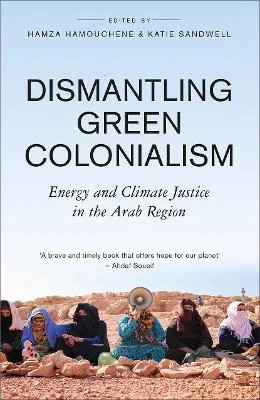
Description
Edited by Hamouchene, Hamza; Edited by Sandwell, Katie
Short /annotation:
Questioning energy transition in the Arab region using a climate justice lens
:
”A thought-provoking book which empowers its readers to think about the problems in systematic, transformative ways” – Fadhel Kaboub, President of the Global Institute for Sustainable Prosperity
The Arab region is a focus of world politics, with authoritarian regimes, significant fossil fuel reserves and histories of colonialism and imperialism. It is also the site of potentially immense green energy resources.
The writers in this collection explore a region ripe for energy transition, but held back by resource-grabbing and (neo)colonial agendas. They show the importance of fighting for a just energy transition and climate justice – exposing policies and practices that protect global and local political elites, multinational corporations and military regimes.
Covering a wide range of countries from Morocco, Algeria and Tunisia to Egypt, Sudan, UAE, Saudi Arabia, Jordan and Palestine, this book challenges Eurocentrism and highlights instead a class-conscious approach to climate justice that is necessary for our survival.
Table of contents:
Tables and Figures
Acknowledgements
Abbreviations
Introduction: Just in Time – The Urgent Need for a Just Transition in the Arab Region – Hamza Hamouchene and Katie Sandwell
PART I: ENERGY COLONIALISM, UNEQUAL EXCHANGE AND GREEN EXTRACTIVISM
1. The Energy Transition in North Africa: Neocolonialism Again! – Hamza Hamouchene
2. An Unjust Transition: Energy, Colonialism and Extractivism in Occupied Western Sahara – Joanna Allan, Hamza Lakhal and Mahmoud Lemaadel
3. Arab–Israeli Eco-Normalization: Greenwashing Settler Colonialism in Palestine and the Jawlan – Manal Shqair
4. What Can an Old Mine Tell Us about a Just Energy Transition? Lessons from Social Mobilization across Mining and Renewable Energy in Morocco – Karen Rignall
5. Towards a Just Agricultural Transition in North Africa – Saker El Nour
6. The Electricity Crisis in Sudan: Between Quick Fixes and Opportunities for a Sustainable Energy Transition – Razaz H. Basheir and Mohamed Salah Abdelrahman
PART II: NEOLIBERAL ADJUSTMENTS, PRIVATISATION OF ENERGY AND THE ROLE OF INTERNATIONAL FINANCIAL INSTITUTIONS
7. International Finance and the Commodification of Electricity in Egypt – Mohamed Gad
8. The Energy Sector in Jordan: Crises Caused by Dysfunctional and Unjust Policies – Asmaa Mohammad Amin
9. Renewable Energy in Tunisia: An Unjust Transition – Chafik Ben Rouine and Flavie Roche
10. The Moroccan Energy Sector: A Permanent Dependence – Jawad Moustakbal
PART III: FOSSIL CAPITALISM AND CHALLENGES TO A JUST TRANSITION
11. A Transition to Where? The Gulf Arab States and the New ”East-East” Axis of World Oil – Adam Hanieh
12. The Challenges of the Energy Transition in Fossil Fuel Exporting Countries: The Case of Algeria – Imane Boukhatem
13. Unjust Transitions: The Gulf States” Role in the “Sustainability Shift” in the Middle East and North Africa – Christian Henderson
About the Contributors
Index
Review quote:
”Demonstrates that the climate crisis – along with mainstream responses to it – is playing out along colonial lines. It”s time to face up to this reality and build an anti-colonial struggle in response.”
Review quote:
”This groundbreaking volume by scholars deeply embedded in the region”s political and knowledge production milieus, offers a timely, indeed acute, analysis of what a just transition might mean for the region. The authors examine in theoretically and empirically rich essays contestations over the Sahara, greenwashing Israel”s colonisation of Palestine, agr




Reviews
There are no reviews yet.