
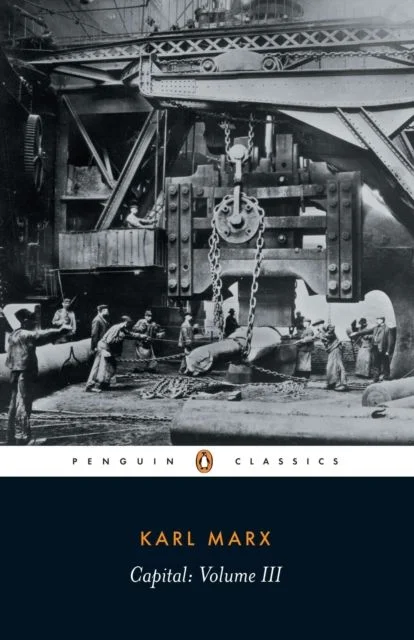
Description
By (author) MARX; By (author) Marx, Karl; Introduction by Mandel Ernest; Translated by Fernbach, David
Short /annotation:
Asserts that – regardless of the efforts of individual capitalists, public authorities or even generous philanthropists – any market economy is inevitably doomed to endure a series of worsening, explosive crises leading finally to complete collapse.
:
Unfinished at the time of Marx”s death in 1883 and first published with a preface by Frederick Engels in 1894, the third volume of Das Kapital strove to combine the theories and concepts of the two previous volumes in order to prove conclusively that capitalism is inherently unworkable as a permanent system for society. Here, Marx asserts controversially that – regardless of the efforts of individual capitalists, public authorities or even generous philanthropists – any market economy is inevitably doomed to endure a series of worsening, explosive crises leading finally to complete collapse. But healso offers an inspirational and compelling prediction: that the end of capitalism will culminate, ultimately, in the birth of a far greater form of society.
Table of contents:
Introduction by Ernest Mandel
Preface (Frederick Engels)
BOOK III: THE PROCESS OF CAPITALIST PRODUCTION AS A WHOLE
PART ONE: THE TRANSFORMATION OF SURPLUS-VALUE INTO PROFIT, AND OF THE RATE OF SURPLUS-VALUE INTO THE RATE OF PROFIT
Chapter 1: Cost Price and Profit
Chapter 2: The Rate of Profit
Chapter 3: The Relationship between Rate of Profit and Rate of Surplus-Value
Chapter 4: The Effect of the Turnover on the Rate of Profit
Chapter 5: Economy in the Use of Constant Capital
1. General Considerations
2. Saving on the Conditions of Work at the Workers” Expense
3. Economy in the Generation and Transmission of Power, and on Buildings
4. Utilization of the Refuse of Production
5. Economy through Inventions
Chapter 6: The Effect of Changes in Price
1. Fluctuations in the Price of Raw Material; Their Direct Effects on the Rate of Profit
2. Revaluation and Devaluation of Capital; Release and Tying-Up of Capital
3. General Illustration: The Cotton Crisis 1861-5
Chapter 7: Supplementary Remarks
PART TWO: THE TRANSFORMATION OF PROFIT INTO AVERAGE PROFIT
Chapter 8: Different Compositions of Capital in Different Branches of Production, and the Resulting Variation in Rates of Profit
Chapter 9: Formation of a General Rate of Profit (Average Rate of Profit), and Transformation of Commodity Values into Prices of Production
Chapter 10: The Equalization of the General Rate of Profit through Competition. Market Prices and Market Values. Surplus Profit
Chapter 11: The Effects of General Fluctuations in Wages on the Prices of Production
Chapter 12: Supplementary Remarks
1. The Causes of a Change in the Price of Production
2. The Production Price of Commodities of Average Composition
3. The Capitalist”s Grounds for Compensation
PART THREE: THE LAW OF THE TENDENTIAL FALL IN THE RATE OF PROFIT
Chapter 13: The Law Itself
Chapter 14: Counteracting Factors
1. More Intense Exploitation of Labour
2. Reduction of Wages below their Value
3. Cheapening of the Elements of Constant Capital
4. The Relative Surplus Population
5. Foreign Trade
6. The Increase in Share Capital
Chapter 15: Development of the Law”s Internal Contradictions
1. General Considerations
2. The Conflict between the Extension of Production and Valorization
3. Surplus Capital alongside Surplus Population
4. Supplementary Remarks
PART FOUR: THE




Reviews
There are no reviews yet.